Rokt Ads Policies
Advertisers leverage Rokt to acquire customers at scale in the Transaction Moment. This guide covers format specifications, creative component requirements, and additional policies that ensure professional, compliant, and effective campaigns.
Creative policiesDirect link to Creative policies
Click any component on the ad mockup or select from the list below to reveal its exact policy requirements and constraints.
Creative Copy RequirementsDirect link to Creative Copy Requirements
Rokt requires that all advertising copy on our platform meets professional standards. This section outlines the mandatory standards for all advertising copy on the Rokt platform, ensuring professional, compliant, and effective communication across all campaigns.
General copy standards:
- Include the advertiser’s brand name in the creative copy (title or body copy), even if it appears prominently in the logo.
- Creative titles must be three words or more. If exactly three words are used, the title must not include the customer’s first name. The following patterns are not allowed: a one-word title such as “Congratulations!” or a three-word title with first name, such as “Thank you {rokt.firstname|shopper}”.
- Only refer to the customer’s name '{rokt.firstname|}' once throughout the creative copy.
- Must not directly reference specific page types or interactions with hard-coded text, such as “Your order,” “Your payment,” “Your sign up,” or with phrases like “You just missed out on this discount.”
- Avoid excessive repetitive messaging intended to elicit engagement (e.g., repeating “Get $20 off”). Generally, repeating the same message more than once in each creative component (Value Tag, Title, Body, or CTA) is considered repetitive.
Language, formatting, and style:
- Ensure correct spelling, punctuation, formatting and grammar for the market where the campaign is running (e.g., use "Realise", not “Realize”, for a UK campaign).
- Ensure proper word spacing; merged or overly spaced words (e.g., "winaprize" or "w i n") are not allowed.
- Do not use unnecessary repetition (e.g.,“deals, deals, deals”).
- Do not use excessive punctuation: use each symbol or punctuation mark (such as !, $, #, ?, or *) only once per phrase.
- Do not use gimmicky or emoticon-style punctuation (e.g., ";-)", "<3").
- Do not use all-caps capitalization, including for emphasis words such as FREE or CHEAP.
- Do not use title case capitalization of non-proper nouns; Rokt will determine on a case-by-case basis if a noun can use title case (i.e. to adhere to a Brand’s messaging.)
- Do not use italic, bold, or other modified fonts for emphasis.
Notable exceptions:
- When a Brand’s offering (e.g., ABC Bank Everyday Cash Card) is capitalized as a result of product branding and marketing, we may align our creative capitalization with that of the Brand, provided that the capitalization is also consistent with their website.
- An asterisk “*” is only allowed when referring to the Disclaimer. The asterisk should appear immediately after the referenced text and be used once per unique claim. The disclaimer should begin with an asterisk.
The following content is prohibited:
- Obscene or profane language including swear or curse words and related misspellings.
- Manipulative, shaming, or emotionally coercive language (e.g. "Stop being lazy." or "Hurry, only losers miss this deal!")
- Sexually suggestive language.
- References to other brands within creative messaging or imagery, unless a strategic relationship or proper licensing and verifiable business permissions exists between entities.
- Add-to-purchase language that suggests an action is directly tied to the customer's recent purchase, unless express consent has been granted by the partner. Reward-based messaging (e.g., "Your {customer action} earned") is acceptable.
- Text that assigns a label to, or implies knowledge of, a customer based on Sensitive Personal Information or personal attributes (e.g., age, health, disability, gender identity), including phrasing like "Hi parent," "As a diabetic...," or "For seniors like you." Possessive or aspirational marketing language that speaks to general consumer interests is permitted, including phrasing like "Your dog will love this," "Protect your home," or "For pet owners."
- Offer messaging that is misaligned with Rokt's accuracy policies and Landing Page requirements, including claims that do not match the offer presented on the landing page (e.g., promoting exclusivity or urgency such as "Limited time offer", unless this is substantiated and/or reflected on the landing page).
Approval decision examples
| Example creatives | Approval decision |
|---|---|
| Click for the latest fashion trends and hottest sales! Get 10% off your first purchase. | Rejected—Advertiser brand missing |
| Receive 20% off when you register! Register today and receive 20% off. | Rejected—Repetitive messaging to elicit engagement |
| ABC Apparel has the latest fashion trends and hottest sales! Get 10% off your first purchase. | Approved—the Advertiser and offer are clearly articulated. |
| [Creative Title] Congrats, {rokt.firstname|to you}! | Rejected—Creative title is fewer than 3 words |
| [Creative Title] Thank you, {rokt.firstname|shopper}! | Rejected—Creative title is exactly three words and uses {rokt.firstname} |
| Purchase a new phone for $10 from Acme Company. | Rejected—Not clear that the offer is condition dependent. |
| Purchase a new phone for $10 on a 24 month plan from ABC Company. Terms & Conditions. | Approved—Clear to the user what will happen next and acknowledges the conditions associated with the offer. Note: Terms & Conditions will be a clickable link. |
You've been chosen by Partner name to get four tickets to ABC cinema for a dollar. Find out how! | Rejected—Suggests affiliation and recommendation on the Partner’s behalf. |
| Acme Apparel has the latest fashion trends and hottest SALES! Get 10% off your first purchase. | Rejected—Inappropriate capitalization in the word SALES |
| Win a free balloon from Acme Company. Click yes please to find out more!!! | Rejected—Repeat exclamation marks. |
Use of Testimonials and Unsubstantiated ClaimsDirect link to Use of Testimonials and Unsubstantiated Claims
Creative copy can express enthusiasm or hyperbole using clearly attributed customer testimonials or opinions (e.g., “‘I live in these sneakers!’ - John S.”). Enthusiastic language should be clearly subjective and not imply factual guarantees. Claims related to health, medical outcomes, financial results, or performance guarantees must be supported by credible and verifiable evidence. Such claims will be subject to rigorous review and should avoid suggesting certainty or universal applicability without clear substantiation.
Advertisers can utilize customer-style testimonials in ad copy, provided they:
- Use quotation marks clearly indicating testimonial content,
- Reflect genuine personal experiences or subjective opinions (e.g., “I love this product”),
- Do not include unverifiable or misleading factual claims (e.g., “#1 best-selling shoes nationwide” without substantiated proof). Clearly subjective enthusiasm (e.g., “These are the best shoes I’ve ever worn!”) is permitted with proper attribution within the creative copy, and
- Preserve original meaning and context when editing or shortening testimonials.
Advertisers are encouraged to use disclaimers to clarify limitations or context, particularly if claims could potentially mislead or set unrealistic expectations.
Image RequirementsDirect link to Image Requirements
As a Brand, you’ll show a logo or product image alongside your creative text in some layouts. Images are not guaranteed to be displayed alongside the creative text, so the creative text must communicate the message and adhere to the broader campaign policies independently to the image.
Rokt layouts support the following image formats:
- A brand logo is a brand logo or wordmark without other content.
- A brand icon is a small icon representing the brand.
- A product image is an image that showcases the use of a product or service.
- A credit card image is an icon, or card art, of a credit card(s) or payment method(s).
Rokt requires that all imagery on our platform meets professional standards and complies with our broader campaign policies. Our Digital Asset Manager makes it very easy for Brands to adhere to these requirements and they are provided in detail below for reference.
General Requirements:
- All images must be high-quality to ensure they render well on all devices. Exact requirements are outlined in the formatting table, below.
- All meaningful logo or image content must be clear and legible at a width of 600px (note: illegible retail packaging and cardholder names on credit cards are acceptable).
- All images must comply with Rokt’s broader campaign policies, including those regarding prohibited, sensitive, and illegal content. As a general rule, any image that depicts violence, harm, discrimination, or could evoke discomfort or distress is unacceptable. Our approval committee will exercise discretion when reviewing any questionable images.
- Brands must own the rights to the image or have proper licensing and verifiable business permissions to use them.
- All imagery must be static; animation is not permitted.
- Watermarks are not permitted.
- Do not use high-contrast, non-brand, or visually distinct colors to create artificial borders or padding.
Logo and Credit Card Requirements:
- Logos may be a brand or product logo/name and should occupy at least 80% of the overall image area.
- Logos and credit card images require a transparent background.
- Logos and credit card images must not be white or very light in color, so they stay clearly visible on white (#FFFFFF) backgrounds.
Product Lifestyle Image Requirements:
- Product images cannot have a transparent background.
- A product image must be directly related to your product or service. For example, a smiling face is acceptable for a dental product/service, but unacceptable for food subscription. Rokt has complete discretion when deciding what is appropriate.
- All images must comply with Rokt’s broader campaign policies, including those regarding prohibited, sensitive, and illegal content. As a general rule, any image that depicts violence, harm, discrimination, or could evoke discomfort or distress is unacceptable. Our approval committee will exercise discretion when reviewing any questionable images.
- Logos may be overlaid on product images, provided the logo occupies at least 20%, but no more than 50%, of the total image area, and does not obstruct or significantly diminish the visibility or recognizability of the core product imagery. Note: there are different requirements if an image is targeted only to Hero format, outlined below.
Brands can submit 1.91:1 Product Lifestyle images for dynamic rendering across multiple layouts, or specifically target the larger Image creative for Hero image rendering. For these Image creatives we allow the use of overlaid content (promotional elements, superimposed logos, or brand text) onto the image. Below are the requirements for Hero targeted images.
Hero Image Requirements:
- Overlaid content must occupy at least 10%, but no more than 50%, of the total image area, and must not obstruct or significantly diminish the visibility or recognizability of the core product imagery.
- Superimposed logos or text that is an inherent part of the image, such as branding, product names, or legally required information, is permitted if all requirements for overlaid content are met.
- A promotional element can be featured in Product Images to provide ancillary information about the brand, product and/or offer. Examples of promotional elements include, but are not limited to: brand or product star ratings, strikethrough pricing, text, and discounted pricing.
- Limit the number of unique overlaid content types to three or fewer per image.
- Keep overlaid text minimal and concise; avoid paragraphs.
- Visual separation is required for elements superimposed on busy backgrounds. Advertisers must use semi-transparent or opaque background elements with at least 50% opacity, if necessary for clarity.
- Overlaid content must not resemble, imply, or mimic interactive or clickable elements (e.g., buttons or CTAs). They should clearly appear as static, informational visuals and must not mislead users into attempting interaction.
- Overlaid content must use high-contrast colors (excluding neon) and clearly legible fonts, and remain readable when the image is scaled to 600px width.
- Disclaimers must be used to clarify any claims.
- Note: Sensitive advertisers may not be eligible for Hero format.
This table outlines the required image assets, formats, and specifications needed to ensure consistent, high-quality rendering across all layouts:
| Item | Requirements | Example(s) |
|---|---|---|
| Brand Logo | - File formats: .png - Aspect ratio: 1:1 & 1.91:1 - Square 1:1 ∘ Minimum: 600 x 600 ∘ Recommended: 1200 x 1200 - Rectangular 1.91:1 ∘ Minimum: 600 x 314 ∘ Recommended: 1200 x 628 - Max file size: 10MB - Transparency: Required - Cropping: Logo should be tightly cropped and occupy at least 80% of the image area. Minimize padding or empty space around the icon or wordmark to ensure visual impact. - Dark mode: Recommended to provide both a light and dark version of the logo for optimal visibility across different backgrounds. |  1:1 icon based logo  1:1 combination of icon and wordmark  1.91:1 combination of icon and wordmark |
| Brand Icon | - File formats: .png, .jpg - Aspect ratio: 1:1 - Square 1:1 ∘ Minimum: 600 x 600 ∘ Recommended: 1200 x 1200 - Max file size: 10MB - Transparency: No transparency - Cropping: Key visual elements should lay within the border provided in One Platform upload process. This will allow your icon to be centered and fully visible when rendered in a circle. |  1:1 brand icon |
| Product Lifestyle Image | - File formats: .png, .jpg - Aspect ratio: 1:1 & 1.91:1 - Square 1:1 ∘ Minimum: 600 x 600 ∘ Recommended: 1200 x 1200 - Rectangular 1.91:1 ∘ Minimum: 600 x 314 ∘ 1200 x 628 recommended |  1:1 product or lifestyle image |
| Credit Card Image | - File formats: .png - Aspect ratio: 1.91:1 - Rectangular 1.91:1 ∘ Minimum: 600 x 314 ∘ Recommended: 1200 x 628 - Max file size: 10MB - Transparency: Required - Cropping: Card image(s) should be tightly cropped. Minimize padding or empty space around the image to ensure visual impact. | 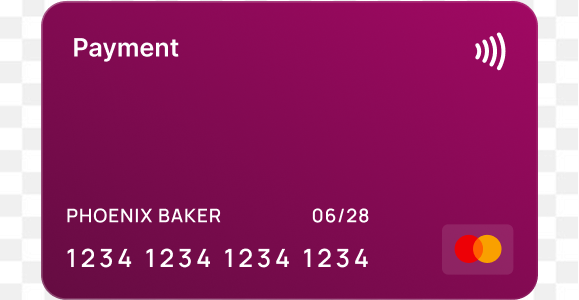 1.91:1 credit card image, transparent background |
T&Cs, Privacy & DisclaimerDirect link to T&Cs, Privacy & Disclaimer
Terms & conditions, privacy policies, and/or disclaimers are used to ensure compliance and provide transparency. Additional requirements may apply as required by law or by Rokt.
Visible disclaimers are required when:
- Mandated by law: Any disclosures, warnings, or specific wording required by regulation must be clearly stated (e.g., age restrictions for alcohol, hotline numbers for gambling services, etc. ).
- Material conditions or limitations exist: Any condition that would significantly alter the customer's understanding or consideration of an offer, such as paid memberships or general cost disclosures (e.g., "$10 phone with 24-month plan required" or "subscription required").
- Advertiser-vertical specific requirements apply: For verticals where additional policies help maintain compliance and enhance transparency, such as paid cashback/rewards, visible disclaimers can be used to detail ongoing costs after a trial period or other key eligibility requirements.
- Context is required: For claims that need to be clarified, qualified, or substantiated.
Disclaimers are generally not required for the following, unless where legally mandated: customer status qualifiers (e.g., "new customers only"), recurring costs following a free trial period, or age eligibility (e.g., "18+").
Disclaimers will be displayed in-full below the offer. When using an asterisk in the creative copy, the disclaimer should begin with an asterisk as well.
For terms & conditions and privacy policies, Brands can upload content to Rokt so that it displays within the Rokt layout or provide a link to an external page/s on their site. In either scenario, the customer navigates to the content via clickable text (Terms & Conditions, Privacy Policy) which appears alongside the offer.
| Feature | Definition | Example Use Cases | Format |
|---|---|---|---|
| Terms & Conditions | Any applicable rules related to the Brand’s offer. General terms of use should be covered on the Brand’s site and are not a valid use for Terms & Conditions. | If a customer is entitled to 10% off, the Terms & Conditions must explicitly state all caveats to the offer (e.g., $100 minimum spend, new customers only, expires Jan. 1). | Link to website or freeform text |
| Disclaimer | Applicable limitations and caveats (e.g. fine print) on the material eligibility of the offer. Disclaimers may only be utilized to provide necessary details about the offer that are not included in the Terms & Conditions. Disclaimers must be fewer than 100 characters in length with grammatically correct punctuation, and ending in a period where applicable. Disclaimers must not include URLs - instead, refer to T&Cs for more information. | Fine print for an offer that may be required, by law or by Rokt, to be disclosed (e.g., must be 21+ to participate). | Freeform text |
| Privacy Policy | Disclosure on the handling of customers' data and related privacy concerns. May include data usage, storage, transmission, deletion, etc. | Disclosing how customer data will be used in cases where a customer may be inputting their PII data. | Freeform text, may include link |
Callout TagsDirect link to Callout Tags
Callout tags are short, informational phrases that highlight important aspects of your offer, such as promotional value, social proof, or guarantees. Unlike calls to action (CTAs), callout tags do not urge users to act, but instead emphasize relevant details. Tags are optional and may appear alongside your creative in certain layouts.
There are three types of callout tag: Promotion/Value, Social Proof, and Offer Guarantee. These tags are optional. Below are the character and guidelines for each:
General Callout Tag Requirements:Direct link to General Callout Tag Requirements:
- Text Limit: Maximum 20 characters
- Tags must comply with general Creative Copy Requirements, emphasizing:
- Accuracy, verifiability, and full adherence to legal and regulatory standards.
- Clear alignment with the associated offer or landing page content.
- No use of all-caps or title case for non-proper nouns.
- Tags must be specific, using precise amounts, timeframes, or percentages where possible.
- Avoid vague, subjective, or unverifiable language.
- Disclaimers must be used to clarify conditions.
- Do not use verbiage that functions as a CTA (e.g. "Get $20 off", "Save $20", or "Win a prize").
- Do not use ending punctuation (i.e. "!", ".","?").
Promotion/Value Callout Tags:Direct link to Promotion/Value Callout Tags:
- Use Case: Highlighting a specific value, tangible offer (such as discounts), or limited-time deals (where promotional end dates are defined).
- Acceptable Examples: "$10 bonus", "Free sample", "30 day free trial", "$200 in bonus bets", "Welcome bonus", "Bundle", "Donation", "Gifting", "Seasonal offer", "Limited time".
Social Proof Callout Tags:Direct link to Social Proof Callout Tags:
- Use Case: Displaying popularity signals of the offer, product or brand (e.g., number of customers, reviews, ratings)
- Acceptable Examples: "20,000 customers", "1 million purchases", "Voted best app 2024", "5-star rated by 1M users", "Bestseller".
- Use timeframes and context disclaimers as applicable and ensure all claims are verifiable on your website or with provided documentation.
- Prohibited Content: Do not use claims that are unsubstantiated, broad, or subjective (e.g., "Most loved app," "Most awarded brand," or "Most claimed offer") unless accompanied with verifiable context. Additionally, do not use claims that change quickly (e.g. "1,255 5-star reviews").
Offer Guarantee Callout Tags:Direct link to Offer Guarantee Callout Tags:
- Use Case: Emphasizing trust signals, such as satisfaction guarantees, returns, or flexible terms.
- Acceptable Examples: “30-day returns”, “24hr cancellation", “Money back guarantee”, “Cancel anytime”, “No lock in contract.”
- Prohibited Content: Avoid legal jargon (e.g., “Void where prohibited”).
Call to Action (CTA) RequirementsDirect link to Call to Action (CTA) Requirements
All creative formats include a positive call to action (CTA) that must be compliant with our Creative Copy Requirements. While all creatives are usually displayed with both a positive and negative call to action, only the positive call to action is customizable by the advertiser, with a limit of 20 characters.
Positive CTA Requirements:
- Text Limit: Maximum 20 characters.
- Must use sentence case (e.g., "Yes please"). Its capitalization may be controlled by the partner site.
- Do not use ending punctuation (i.e., "!", ".", "?").
- Do not use emoticon-style characters (e.g., ";-)", "<3").
- Do not use language that could be confused with broader Partner site navigation commands (e.g., "Next," "Continue," "Proceed," "Advance").
- Acceptable Examples: "Claim now", "Sign up", or "Yes please". The most common is "Yes please" and its non-English equivalents (e.g., Sí, por favor; Oui, merci; Ja, bitte; はい、お願いします).
The negative call to action is typically displayed alongside the positive CTA, and may be overridden by a Partner’s hard-coded preferred verbiage (e.g. “Next”). The default for all English creatives is "Decline", or its non-English equivalent, and is not customizable by the advertiser.
The default negative CTA for each language: English: "Decline", Spanish: "Rechazar", German: "Ablehnen", French: "Décliner", Japanese: "結構です", Dutch: "Weigeren", Italian: "Declinare", Swedish: "Avböj", Danish: "Nej tak".
Offer format requirementsDirect link to Offer format requirements
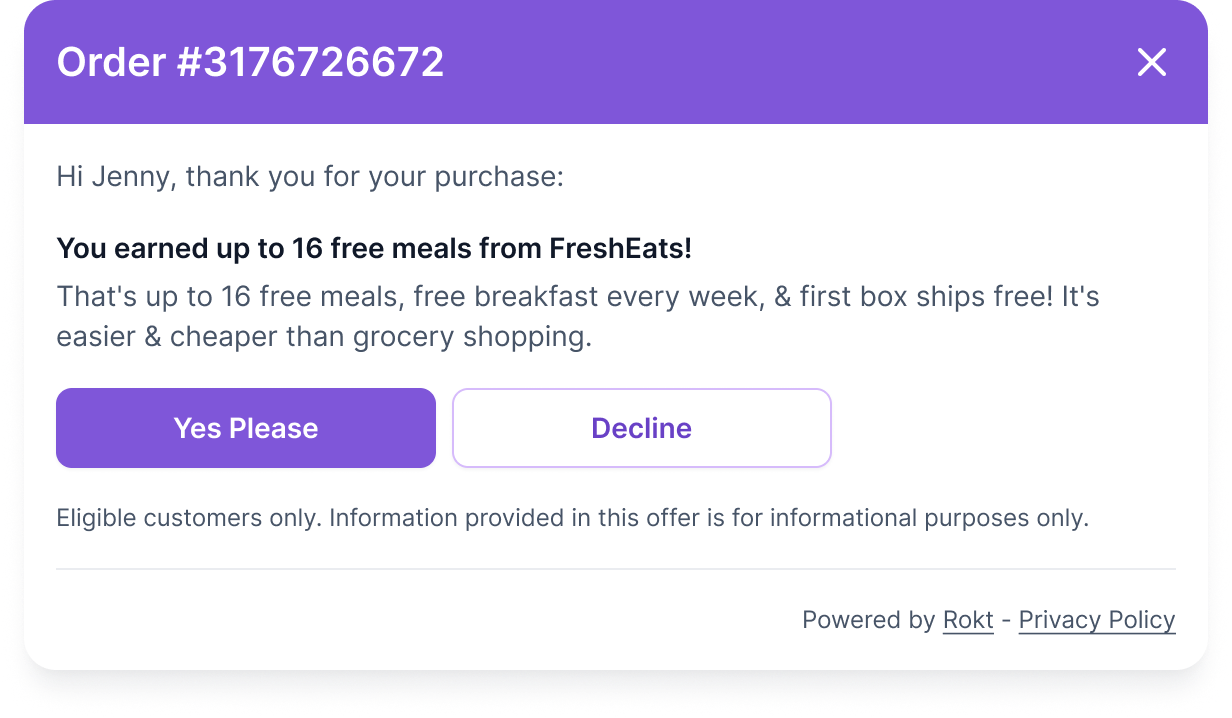
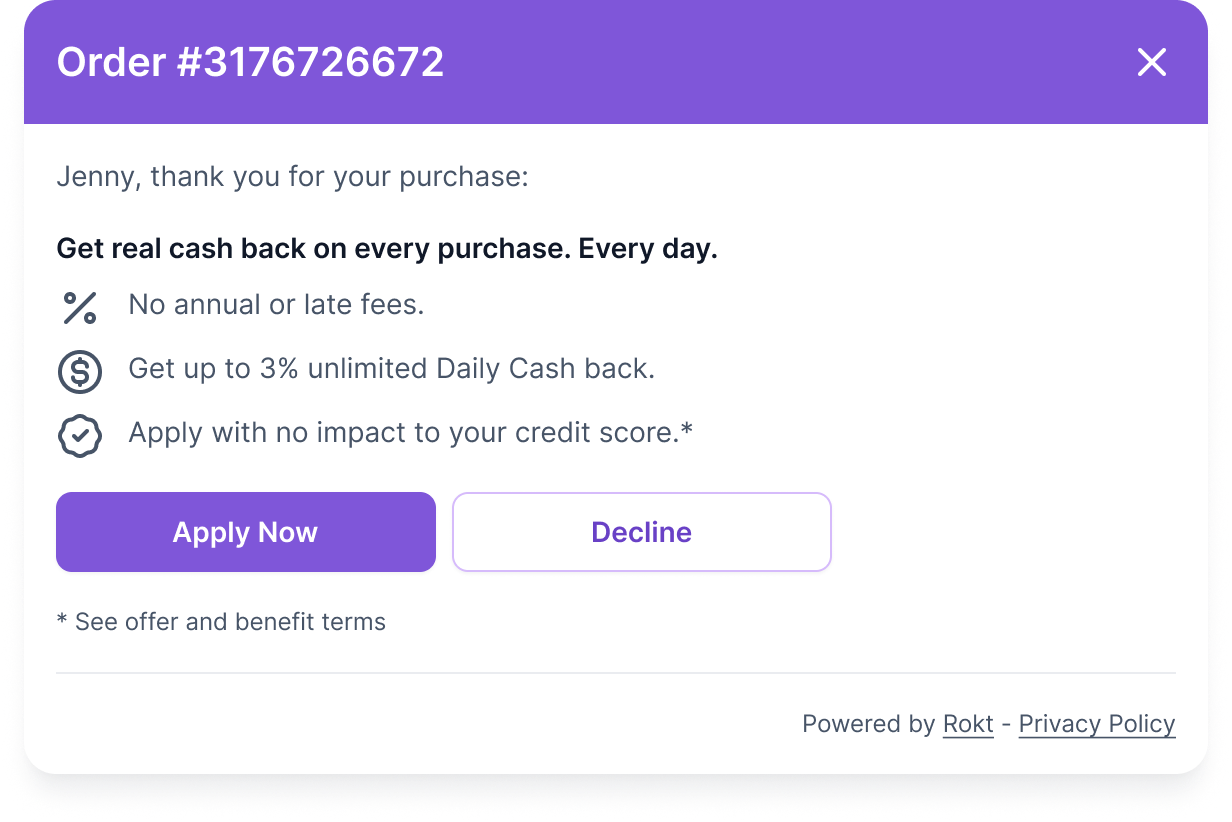
There are several creative formats available on Rokt layouts, including Standard, Benefits, Compact, and Savings. Below are the character and image guidelines for each format:
Use CaseDirect link to Use Case
General offer messaging
Text Components & LimitsDirect link to Text Components & Limits
- Title: Minimum 5 characters and maximum 50 characters
- Title & Body Copy: Maximum 175 characters combined. Specifically, Body Copy may be up to 175 characters, less characters used in Title.
- Positive Call to Action (CTA): Maximum 20 characters.
Permitted Image TypesDirect link to Permitted Image Types
Brand Logo, Brand Icon, Product Image, Credit Card Image.
Use CaseDirect link to Use Case
Highlighting multiple key features or benefits of an offer
Text Components & LimitsDirect link to Text Components & Limits
- Title: Minimum 5 characters and maximum 80 characters (Must include brand name)
- Benefits Copy: Each individual benefit point text has a maximum limit of 50 characters. You must provide 3 distinct benefit points and use consistent punctuation.
- Positive Call to Action (CTA): Maximum 20 characters.
In instances where icons are not supported, due to certain technical integrations (e.g. iOS in-app experiences) or partner controls, bullet points will replace selected icons.
Permitted Image TypesDirect link to Permitted Image Types
Brand Logo, Brand Icon, Product Image, Credit Card Image. See Image Requirements for details.
Use CaseDirect link to Use Case
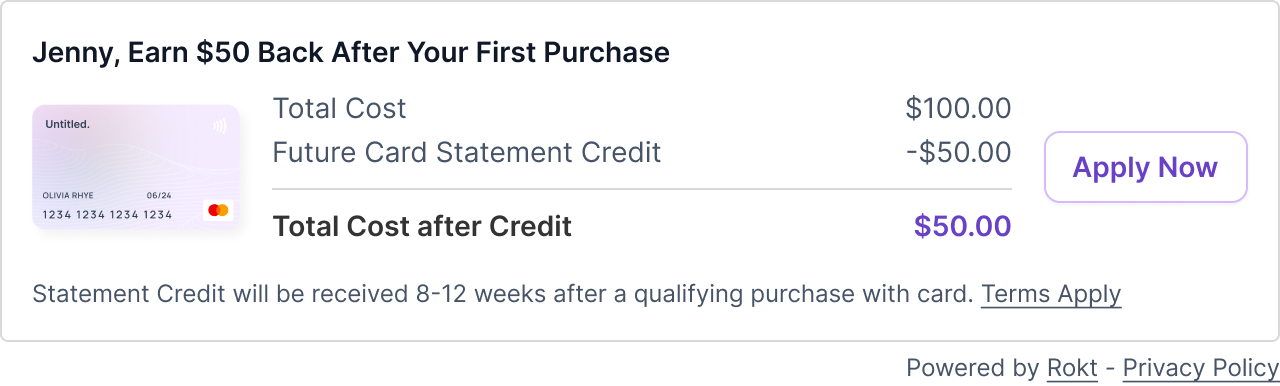
Clearly presenting a specific monetary saving or discount amount
Text Components & LimitsDirect link to Text Components & Limits
- Title: Minimum 5 characters and maximum 125 characters. (Note: We recommend keeping titles under 100 characters for optimal display across devices).
- Promotion or discount amount: Values expressed as a dollar amount (see example)
- Positive Call to Action (CTA): Maximum 20 characters.
Permitted Image TypesDirect link to Permitted Image Types
Brand Logo, Brand Icon, Credit Card Image. See Image Requirements for details.
Use CaseDirect link to Use Case
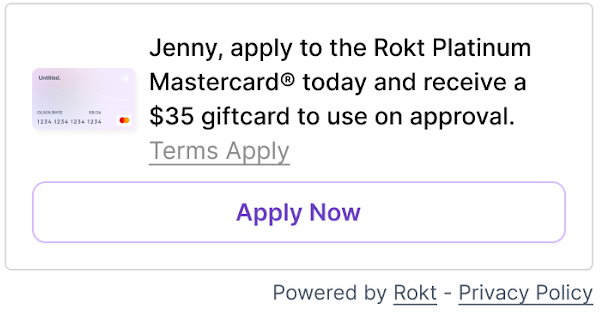
Minimalist creative messaging that focuses on the brand and associated offer
Text Components & LimitsDirect link to Text Components & Limits
- Title: Maximum 125 characters
- Positive Call to Action (CTA): Maximum 20 characters.
Permitted Image TypesDirect link to Permitted Image Types
Brand Icon, Credit Card Image. See Image Requirements for details.
Use CaseDirect link to Use Case
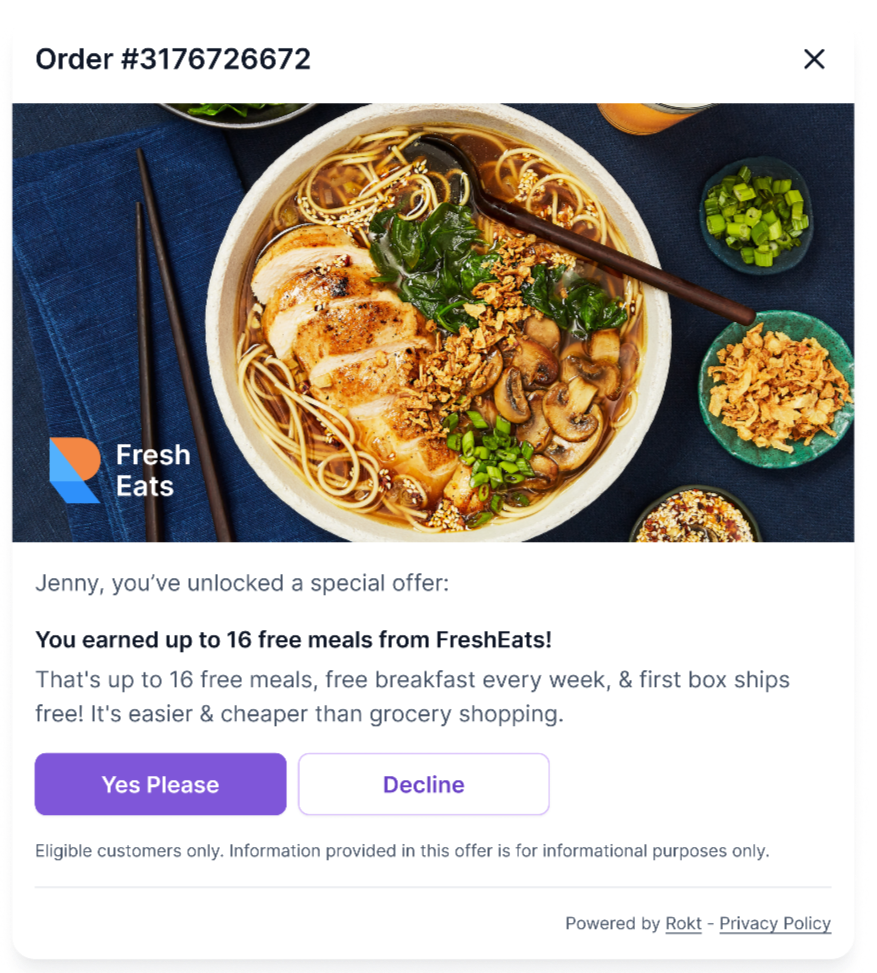
A large headline image alongside a creative title, body and a CTA
Text Components & LimitsDirect link to Text Components & Limits
- Title: Minimum 5 characters and maximum 50 characters
- Title & Body Copy: Maximum 175 characters combined. Specifically, Body Copy may be up to 175 characters, less characters used in Title.
- Positive Call to Action (CTA): Maximum 20 characters.
Permitted Image TypesDirect link to Permitted Image Types
Product Image. See Image Requirements for details.
Additional policiesDirect link to Additional policies
Additional requirements covering advertiser verticals, targeting, data protection, landing pages, email campaigns, and performance thresholds.
Advertiser-vertical specific requirements
Advertiser-vertical specific requirementsDirect link to Advertiser-vertical specific requirements
To meet industry regulations and ensure a clear customer experience, it is necessary for certain advertiser categories to have additional campaign, audience and creative requirements. These policies help maintain compliance and enhance transparency.
Paid Cashback and Rewards and Retail Insurance advertisers must adhere to the following requirements:Direct link to Paid Cashback and Rewards and Retail Insurance advertisers must adhere to the following requirements:
- Clear third-party identification: Include the brand name in the creative title and any imagery tied to the creative.
- Transparent cost disclosure: Creative must visibly state a paid subscription and/or the monthly or annual cost beyond a trial period.
- Accessible terms & conditions: Present T&Cs, which can be hyperlinked to a dedicated tab or directly to the advertisers’ website.
- Avoid referencing the completed transaction: Refrain from using language that connects offer redemption to the purchase the customer just completed. Examples of prohibited phrases include "cash back on today's offer" or "cash back on this order”.
Sports Betting, Casino and Gaming, and Lotto advertisers must adhere to the following requirements, where applicable:Direct link to Sports Betting, Casino and Gaming, and Lotto advertisers must adhere to the following requirements, where applicable:
- Geographic targeting: Campaigns may only target locations (countries, states, or regions) where the promoted activity is legal and where the Advertiser holds the necessary license or regulatory approval to serve gambling ads.
- Age targeting: Campaigns may only target customers who are of legal age to purchase or use the promoted products or services.
- Age restriction: Clear age restriction must be included in the creative copy or disclaimer as specified by law, e.g. "Must be 21+ to participate." or "18+ only.".
- Responsible gaming language and hotline information are required disclaimers as specified by law for applicable categories (e.g. Online Casinos, Sports Betting).
- Customer eligibility: For promotions, bonuses, and offers, eligibility must be specified (e.g. state residency or jurisdictional limitations, minimum deposit requirements, or time-limited offers).
- Avoid any guarantees: No offer should suggest that social, financial, or personal success is guaranteed. In other words, no suggestion that gambling is "risk free".
Following these requirements supports a positive experience for customers, advertisers, and our network, driving stronger outcomes for all parties.
Credit cards and loan advertisers must adhere to the following requirements:Direct link to Credit cards and loan advertisers must adhere to the following requirements:
- Targeting: Campaigns are prevented from using advanced targeting features based on protected classes or proxies, as required by law or by Rokt.
- We remove age, gender, and granular location data (e.g. zip codes) from targeting options in the United States, Canada, and Europe, and disable Rokt Machine Learning from considering those attributes when adjusting advertiser bid amounts.
Alcohol and Wine Sellers advertisers must adhere to the following requirements:Direct link to Alcohol and Wine Sellers advertisers must adhere to the following requirements:
- Age targeting: Campaigns may only target customers who are of legal age to purchase or use the promoted products or services; for example:
- US: 21+
- UK: 18+
- Age restriction: Clear age restriction must be included in the creative copy or disclaimer as specified by law, e.g. "Must be 21+ to participate." or "18+ only."
Sweepstakes advertisers must adhere to the following requirements:Direct link to Sweepstakes advertisers must adhere to the following requirements:
- Age targeting: Campaigns may only target customers who are of legal age to enter the sweepstakes.
- Age restriction: Clear age restriction must be included in the creative copy or disclaimer as specified by law, e.g. "Must be 21+ to participate." or "18+ only."
- No purchase necessary: Sweepstakes campaign must not require a purchase or payment to enter. An alternative free method of entry (AMOE) must be clearly provided and disclosed on the advertiser’s landing page.
- Transparent cost disclosure: For sweepstakes requiring paid digital entry, accompany creatives with a disclaimer that references the paid entry cost.
Audience targeting requirements
Audience targeting requirementsDirect link to Audience targeting requirements
Rokt allows Brands to show campaigns to specific groupings of customers. Rokt sets policies to ensure that personalization is appropriate, measured, and does not negatively impact the customer experience. As such, Brands must not:
- Target customers for which their products or services are not suitable or appropriate. For example, alcohol Brands must restrict age targeting to appropriate age in the market, i.e., 21+ in the US.
- Use sensitive personal information (defined below) for the purpose of forming audiences and targeting.
- Present campaigns or links to any sites that contain, assert, or imply knowledge (whether true or not) of any sensitive personal information.
- Target, or upload the data of, children under 16.
What is Sensitive Personal Information?Direct link to What is Sensitive Personal Information?
Sensitive personal information is considered, in its broadest sense:
- Sexual behavior or orientation.
- Racial or ethnic information.
- Political affiliation.
- Trade union membership.
- Religion or religious/philosophical belief.
- Negative financial status or personal hardship.
- Health or medical information such as health conditions, treatments or procedures.
- Status as a child under 16.
- Status of having committed or allegedly committed any crime.
- Divorce or marital separation.
This includes all information, whether or not it is correct, or whether actual or inferred.
Audience Targeting with Custom AudiencesDirect link to Audience Targeting with Custom Audiences
Brands may use custom audiences to target or suppress customers across the Rokt network.
To positively target a known individual using PII, a Brand must have that individual’s explicit consent to market to them. That is, the customer should reasonably expect to hear from the Brand due to a pre-existing relationship where the customer provided marketing consent and shared their PII. The Brand can then integrate the PII required to target (e.g., phone or email) with Rokt as a customer list from their CRM or in real time via a Rokt SDK or API integrated with their website or systems.
To retarget a group of unknown individuals (e.g., website visitors), a Brand can rely on device or other non-PII identifiers (e.g., Rokt Click ID) provided the target group includes at least 1,000 individuals and the customers do not receive invasive messaging about specific behaviors.
To exclude (suppress) customers using targeting, a Brand can use either PII or device based IDs without needing minimum target group size.
Coupon requirements
Coupon requirementsDirect link to Coupon requirements
Coupons and coupon codes must be linked to the Brand and creative such that they are consistent with the customer’s consent and expectations when received via email.
Brands are prohibited from using the name "Rokt", or any reference to “Rokt”, in any coupon codes to unlock discounts. "Rokt" is an intermediary technology and not intended for direct consumer-facing promotions.
Customer confirmation emails (CCEs)
Customer confirmation emails (CCEs)Direct link to Customer confirmation emails (CCEs)
Partner branded Customer Confirmation Emails (CCEs) may be used to support a Rokt Ads Campaign to help the customer redeem an offer from the ad campaign.
CCEs are "transactional emails" rather than a conventional "bulk marketing emails". The difference is that a "transactional email" is a direct response to a customer trigger (click/referral) and contains highly valuable information necessary for a customer to take the next step. For this reason, the offer should be differentiated from the Brand's standard marketing offer such that it brings additional value to the customer. This may be in the form of a coupon code, promo code, differentiated landing page and/or offer with an expiry date.
CCEs are supported for instances when a coupon code is required to redeem the offer, and that coupon code is not available on the landing page. Additional use cases are at Rokt's discretion.
CCEs should not be used to support Rokt Ads campaigns with generic branding messages or to introduce new offers. For example, the offer should not be generally available from the Brands' (product) home page (which is easily searchable) or require entry into a sweepstake (offer not guaranteed).
| Details | |
|---|---|
| When are they used? | May be utilized for Rokt Ads Campaigns |
| Who sends it | Rokt (on behalf of the Partner) |
| Purpose | Help the customer redeem an offer from the ad campaign |
| Timing | Must be sent within 1 hour of the referral |
| Volume Allowed | 1 email per campaign |
| Content Rules | Must: - Include the brand name - Clearly articulate the offer - Be offer-specific (not general marketing) - Avoid sweepstakes or homepage links |
| Editorial Compliance | Must follow Rokt campaign editorial guidelines. |
| Unsubscribe Monitoring | Paused at 2% unsubscribe rate (threshold applies after 2,500 sends) |
Note that the CCE sender domain, name, subject line, header and footer are all controlled by the Partner.
Data protection, privacy & security
Data protection, privacy & securityDirect link to Data protection, privacy & security
Any personal information or personal data Brands receive that is collected from customers via a campaign on the Rokt network must not be:
- Disclosed, sold, rented, forwarded, made public.
- Shared in any way with any other third party.
- Used other than to facilitate the services that the customer has consented to participate in or receive from the Brand as specified in the campaign creative.
When storing, transferring and managing this personal information or personal data, all necessary precautions must be taken to prevent a possible data breach and protect against misuse of its consented purpose.
Rokt does not knowingly collect Personal Information from or about children under the age of 13. If we learn that we have collected Personal Information of a child under the age of 13, we will delete that data from our systems. Brands must not knowingly use any personal data about children under the age of 16 when running campaigns on the Rokt network and must cease marketing to any customer referred from the Rokt network if it later becomes evident the customer is under 16.
Landing page requirements
Landing page requirementsDirect link to Landing page requirements
Creatives must include a hyperlink to the Brand’s landing page. Rokt sets and enforces policies around links and their associated landing pages.
Links and landing pages must:
- Use HTTPS protocol.
- Contain offers matching and relevant to those indicated in the creative copy.
- Be viewable in commonly used browsers like Chrome, Safari, Edge and FireFox.
Links and landing pages must not:
- Contain any deceptive or prohibited content or techniques.
- Contain any personally identifiable information (PII).
- Link to a page where the back button is disabled or which interferes with a customer’s capacity to navigate.
Other requirements:
- Brands must not substantively update their linked landing pages without notifying their Rokt account manager or emailing support@rokt.com.
Performance thresholds
Performance thresholdsDirect link to Performance thresholds
CreativeDirect link to Creative
Rokt utilizes a variety of measures to monitor performance. Most notably we enforce a minimum Quality Score (QS) cut off to ensure a minimum level of customer relevance and client value. Any creative that falls below the level isn’t eligible to display. Minimum thresholds are defined by Rokt and can vary by region and partner. We also monitor bounce rate from the landing page - indicating a disconnect in the customer expectations. Whilst bounce rates are factored into Rokt’s predictions, we may take action to pause a campaign if bounce rates are excessively high.
Email Campaigns (Nurture and Customer Confirmation Emails)Direct link to Email Campaigns (Nurture and Customer Confirmation Emails)
The performance of email campaigns (both Nurture and Customer Confirmation Emails), measured through their Unsubscribe Rate, will be actively monitored to ensure they meet the expectations of customers and avoid compromising email sender domains and deliverability. Users will be notified via email and in Rokt One Platform once the warning threshold is reached.
Email campaigns will be automatically paused when the pause threshold is reached, with automated alerts delivered to the campaign account manager via email. The campaign audience will continue to run provided coupon delivery is not required. If coupon delivery is required, and all nurtures are paused, the campaign audiences will also be paused to ensure the customer expectation is met. Paused email creatives due to underperformance are unable to be re-enabled. Instead, a new email creative must be created and approved before setting live.
Unsubscribe Rate Thresholds (based on rolling 30 days of data):
| Email Type | Warning Threshold | Pause Threshold* |
|---|---|---|
| Customer Confirmation Emails | 1% | 2% |
| Nurture Emails | 1% | 2% |
| *Note that there is a minimum volume of 2,500 sends before pause thresholds are enabled for a given campaign. |